classaquitatui, vip touti, harem curitiba, acompanhantes tatui, classeaquitatui, acompanhantes boituva, classitatui, acompanhante tatui, classiaqui, acompanhante votorantim, touti, classiaqui tatui, acompanhante tatuí, acompanhantes em itapetininga, photo acompanhante itapetininga, harem 69, harem69, acompanhante cerquilho, photoac9mp, acompanhantes votorantim, acompanhantes tatuí, photoacompanhante americana, acompanhantes em tatui, acompanhante programa, garota de programa tatui, acompanhantes em boituva, photoacomp americana, acompanhante em boituva, acompanhantes de itapetininga, acompanhante em tatuí, sara e eloá, trepada gostosa, menina de programa, acompanhantes em tatuí, photo acompanhante tatui, acompanhantes cerquilho, classiaquitatui, acompanhante em tatui, garota de programa boituva, garota de programa de tatuí, classiaqui itapetininga, acompanhantes trans americana, acompanhantes em cerquilho, foto acompanhante itapetininga, acompanhante de luxo itapetininga, photoacompanhante tatui, akemi pelada, garota de programa tatuí, classiaqui tatuí, garota de programa em itapetininga, acompanhantes de tatui, sexo tatui, brenda porno, harem 69 sorocaba, acompanhante de tatui, photoqcompanhantes, putas tatui, garotas de programa tatui, acompanhante em cerquilho, photoacompanhantes itapetininga, acompanhantes porto feliz, foto de buceta fake, photoacompanhante boituva, acompanhante de tatuí, acompanhantes em porto feliz, putas em tatui, garota de programa de tatui, brenda campos nua, foto de buceta de mulher, massagem erotica sorocaba, classi aqui tatui, photo acompanhante boituva, photo acompanhantes itapetininga, garota de programa de porto feliz, photoacompanhantes tatui, garota de programa em cerquilho, acompanhantes de boituva, haren curitiba, acompanhante tiete, dani lopes nua, garota com local tatui, garota de programa votorantim, garota de programa em tatuí, acompanhante de luxo tatui, haren69, garota de programa em tatui, acomp tatui, transex itapetininga, garota de programa cerquilho, modelo julinha pelada, acompanhante tietê, classi aqui tatuí, garotas de programa boituva, garota com local itapetininga, putas de itapetininga, mineirinha nua, acompanhante serena, garotas de programa de tatui, acompanhanates tatui, acompanhante trans tatui, acompanhantes de primavera, fatui, acompanhantetatui, putas de tatui, acompanhantes de tatuí, acompanhantes trans tatui, classiaqui votorantim, travesti sorocaba classiaqui, tatu na bunda, sexo itapetininga, acompanhanate tatui, harem acompanhantes, photo acompanhante jp, garotacomlocal.com, mulher gato sex, garotas de programa em tatuí, garota de programa em votorantim, mulher de programa itapetininga, punheta guiasa, classiaqui boituva, putas em boituva, tagui, putas boituva, garotas com local tatui, garoto de programa tatui, garotas de programa votorantim, garotas de programa em votorantim, sexo casual em sorocaba, acompanhante de luxo em itapetininga, aconpanhantes itapetininga, putas votorantim, acompanhantes de votorantim, garota programa cerquilho, foto de buceta gostosa, acompanhantes itapetininga sp, acompanhantes laranjal paulista, acompanhantes em tiete, garota de programa de votorantim, garotas de programa em pinda, app de acompanhantes, garota de programa de cerquilho, 69 de ladinho, mulher de programa de itapetininga, putas em tatuí, acompanhante tatuada, harém 69, classeaquisorocaba, foto de bct rosa, garota com local tatuí, tati dias nua, acompanhantes de luxo tatui, classeaqui, classi aqui sorocaba, yasmin mayla, acompanhante laranjal paulista, putas em votorantim, sexo em tatui, garotas de programa de tatuí, fatalmodel itapetininga, photo acompanhantes jp, buceta rosa foto, acompanhante de luxo em tatuí, garotas c local, garotas de programa tatuí, harem acompanhante, photoacomoantes, classeaqui sorocaba, photo acompanhante votorantim, garota programa boituva, fotos fake de buceta, garota de programa videos, garota de programa em tietê, acompanhante fisting, acompanhante de luxo de tatuí, acompanhantes jp trans, bucetas casadas, acompanhantes casual, acompanhante de luxo tatuí, fazendo 69 gostoso, leticia gabriela nua, garota programa tatui, acompanhantes adulto, haren 69 sorocaba, porno taldaloira, acompanhante classiaqui, foto acompanhante tatui, aconpanhante tatui, photo acompanhantes tatui, acompanhante cesario lange, classaqui tatui, aconpanhantes tatui, mulher de programa de tatuí, acomoanhantes tatui, sexo tatuí, foto acompanhante tatuí, photo acompanhante tatuí, classi adulto tatui acompanhantes, acompanhamtes tatui, acompanhantes trans tatuí, putas de tatuí, acompanhante tatui trans, acompanhantes cesario lange, photoacompanhante cerquilho, photoacomp tatui, acompanhanates tatui, acompanhantes tatui trans, acompanhante cesário lange, tatui acompanhantes, gp em tatui, acompanhantes tatui sp, puta de luxo tatui, acompanhantes tarui, acompanhante luxo tatui, acompanhantes harem, acompanhantes trans em tatui, acompanhantes de luxo cerquilho, photo acompanhantes tatuí, acompanhante tarui, mulheres de programa de tatuí, classiaq tatui, acomoanhante tatui, acompanhamte tatui, acompanhantes cesário lange, acompanhantes de luxo tatuí, acompanhanates de tatui, acompanhantes de luxo em tatuí, mulheres de programa de tatui, acompanhanate tatuí, photoacompanhantes tatuí, mulheres de programa tatui, acompanhantes em tatui sp, sexo em tatuí, acompantes tatui, garota de progama tatui, photoacompanhantestatui, aconpanhantes de tatui, acompanhantes ta, acompnhantes tatui, acompanhante.tatui, gp em tatuí, classeaqui tatui, acompahantes tatui, transex tatui classi, garotas de luxo tatui, garota de programa tatui class aqui+18, garotas de tatuí, garotas em tatui, garotas em tatuí, garota de programa tatui classi, garota de programa tatui class aqui, tatui photoacompanhantes, acompanhante tatui agora, acoponhate garota de programa de tatuí, gp classiaqui tatuí, garotas de tatui, ruiva acompanhante tatui, aconpanhantes em tatuí, classiaqui de tatui, garotas gp tatui, astigmatismo, gerarboletimunificadoexterno, astigmatismo o que é, estigmatismo, o que é astigmatismo, miopia e astigmatismo, photoackmpa, arquidimatismo, larcrm7, sintomas de astigmatismo, o'que é astigmatismo, astigmatismo sintomas, astigmatismo visao, visão de quem tem astigmatismo, hipermetropia e astigmatismo, visão astigmatismo, aquidimatismo, astigmatismo tem cura, miopia e astigmatismo juntos, o que é astigmatismo na visão, astenopia, estigmatismo significado, o que é estigmatismo, visão com astigmatismo, como uma pessoa com astigmatismo enxerga, visão de astigmatismo, o que astigmatismo, astigmatism, miopia astigmatismo, o que e astigmatismo, astigmatismo como enxerga, astigmatismo pode cegar, tratamentos para astigmatismo, teste de astigmatismo, como enxerga uma pessoa com astigmatismo, oq e astigmatismo, miopia e astigmatismo tem cura, o que significa astigmatismo, quem nao enxerga de perto tem oq, graus de astigmatismo, astigmatismo: como enxerga, astigmatismo significado, lente astigmatismo, astigmatismo olho torto, visão astigmatismo miopia, astigmatismo luz, miopia astigmatismo e hipermetropia, estigmatismo ou astigmatismo, oq é astigmatismo, astigmatismo e miopia juntos, astigmatismo é perto ou longe, astigmatismo causas, olho com astigmatismo, teste astigmatismo, visão de quem tem miopia e astigmatismo, visão de uma pessoa com astigmatismo, astigmatismo irregular, astigmatismo o que causa, o'que e astigmatismo, astigmatismo e miopia diferença, astigmatismo visão, o que causa astigmatismo, sintomas astigmatismo, hipermetropia e astigmatismo juntos, o que é astigmatismo no olho, astigmatismo miopia e hipermetropia, como saber se tenho astigmatismo, visao astigmatismo, quem nao enxerga de longe tem oq, astigmatismo é longe ou perto, astigmatismo é miopia, o que é astigmatismo e miopia, astigmatismo lente, como pessoas com astigmatismo enxergam, astigmatismo longe ou perto, eixo do olho, oculos astigmatismo, astigmatismo tratamento, o que é hipermetropia e astigmatismo, óculos para astigmatismo, sintomas do astigmatismo, miopia e astigmatismo juntos pode cegar, astigmatismo alto, astigmatismo ou estigmatismo, astiguimatismo, astigmatismo é para perto ou longe, visão de quem tem astigmatismo e miopia, tipos de astigmatismo, estigmatismo o que significa, quem tem astigmatismo pode usar lente, visão do astigmatismo, astigmatismo perto ou longe, astigmatismo no olho, miopia ou astigmatismo, o que é astigmatismo nos olhos, como enxerga quem tem astigmatismo, astigmatismo a noite, astigmatismo e hipermetropia juntos, eixo astigmatismo, visao de astigmatismo, visao astigmatismo a noite, como enxerga uma pessoa com astigmatismo e miopia, astigmatismo olho, estigmatismo o que é, stigmatismo, visao de uma pessoa com miopia e astigmatismo, astigmatismo luz a noite, visao de quem tem astigmatismo, astigmatismo eixo 180, eixo no exame de vista, oque é astigmatismo, eixo exame de vista, problema de vista astigmatismo, o'que significa eixo no exame de vista, o'que astigmatismo, astigmatismo o'que é, visão com miopia e astigmatismo, miopia com astigmatismo, astigmatismo é grave, astigmatismo oculos, 1 grau de astigmatismo é muito, anisometropia tem cura, visao com astigmatismo, problema de visão astigmatismo, o que causa o astigmatismo, o que significa astigmatismo no olho, óculos com eixo errado sintomas, astigmatismo regular, o'que significa astigmatismo, astigmatismo é para longe ou perto, causas do astigmatismo, astigmatismo pode diminuir, pessoa com astigmatismo, sigmatismo no olho, olho astigmatismo, astigmata, o que é astigmatismo?, astigmatismo como se ve, o que é astigmatismo ocular, astigmatismo ocular, imagem astigmatismo, quem tem astigmatismo, oque e astigmatismo, o que o astigmatismo causa, o que é astigmatismo na vista, pessoas com astigmatismo, vista com astigmatismo, imagem de astigmatismo, astigmatismo miópico, problema no olho astigmatismo, o'que causa astigmatismo, problemas de visão astigmatismo, astigmatismo imagem, astigmatismo nos olhos, como tratar astigmatismo, astigmatismo é de longe ou perto, astigmatismo o que e, esquematismo no olho, o que significa estigmatismo, astigma, significado de astigmatismo, o que estigmatismo, astigmatismo é doença, o que e astigmatismo e miopia, como funciona o astigmatismo, o astigmatismo, astigmatismo olhos, que es astigmatismo, tratamento para astigmatismo, como diminuir o astigmatismo naturalmente, olho de quem tem astigmatismo, o que e estigmatismo, astigmatismo deixa vesgo, como corrigir astigmatismo, astigmatismo como é, o'que é astigmatismo no olho, astigmatismo como tratar, astigmatismo foto, astigmatismo que es, como melhorar o astigmatismo, visao do astigmatismo, astigmatismo obliquo, astigmat, olhos com astigmatismo, como se escreve astigmatismo, astigmatismo infantil tem cura, estigmatismo tem cura, como curar astigmatismo, como é astigmatismo, astigmatismo e estigmatismo, o'que é astigmatismo resumo, astigmatismo vista, o que astigmatismo causa, o que significa astigmatismo nos olhos, astigmatismos, astigmatismo hipermetrópico, google o que é astigmatismo, causa do astigmatismo, oq é estigmatismo, definição de astigmatismo, o que é estigmatismo no olho, astigmatismo imagens, estigmatismo e astigmatismo, astigmatismo é uma doença, astigmatismo é, como corrigir o astigmatismo, que é astigmatismo, astigmatismo regular assimétrico, astigmatismo oq e, esquematismo nos olhos, como diminuir o astigmatismo, astigmatismo correção, o que quer dizer astigmatismo, astigmatismo miopico, oq e estigmatismo, astigmatismo o que significa, o'que causa o astigmatismo, o'que astigmatismo ocular, doença no olho astigmatismo, o que é astigmatismo irregular, como melhorar o astigmatismo naturalmente, oque é estigmatismo, astigmatismo forte, astigmatismo assimétrico, como melhorar astigmatismo, correção de astigmatismo, definição de astigmatismo, astigmatismo como corrigir, como curar o astigmatismo, imagens de astigmatismo, visao com astigmatismo e visao normal, e astigmatismo, astigmatismo de longe, magmatismo no olho, estigmatismo visão, o que causa astigmatismo nos olhos, sintomas de astigmatismo alto, imagens astigmatismo, astigmatismo o'que causa, doença do olho astigmatismo, estimativo no olho, olhos astigmatismo, astigmatismo doi o olho, pessoa que tem astigmatismo, correção astigmatismo, astigmatismo infantil regride, colírio para astigmatismo, o.que é astigmatismo, magnetismo no olho, astigmatismo irregular assimétrico, doença astigmatismo, astigmatismo aumenta com a idade, astigmatismo tem cura natural, doença dos olhos astigmatismo, como tratar o astigmatismo, como diminuir o grau de astigmatismo, qual a causa do astigmatismo, doenças dos olhos astigmatismo, astigmatismo fotos, causas astigmatismo, astigmatismo oblíquo, astigmático, como curar astigmatismo naturalmente, astigmatismo características, astigmatismo fisica, astigmatismo alto sintomas, doenças do olho astigmatismo, astigmatismo longe, astigmatismo o que é?, astigmatismo o que é isso, o que que é estigmatismo, astigmatismo hipermetrópico composto, cura astigmatismo, astigmatismo resumo, astigmatismo hipermetropico, características do astigmatismo, astigmatismo oque e, correção do astigmatismo, o que significa astigmatismo na visão, astigmatismo o que, melhor colírio para astigmatismo, qual o tratamento para astigmatismo, como ocorre o astigmatismo, astigmatismo desenho, visao com astigmatismo e sem, tudo sobre astigmatismo, matismo significado, a correção para o astigmatismo pode ser feita por, estigmatismo ou astigmatismo significado, esquematismo ocular, sigmatismo nos olhos, causas de astigmatismo, sigmatismo olhos, visão de um astigmata, quem tem astigmatismo é, o que é artigo matismo, local de projeção da imagem do olho com astigmatismo, o que é astigmat, astigmatismo na infância tem cura, visao do astigmata, estigmatismo é grave, roda do astigmatismo, olho com astigmatismo local de projeção da imagem, astigmatismo diminui com a idade

SIP Trunk Providers: How They’re Powering the Future of Business Communication

I still remember the day my office phone bill nearly made me spit out my coffee. We were paying thousands for outdated PRI lines, and that’s when I discovered SIP trunk providers. The idea of routing calls through the internet instead of traditional phone lines felt futuristic—and cheaper. Fast forward to today, and I can’t imagine running a business without SIP trunking.

So, what’s behind this global rush toward SIP trunks, and why are companies like Twilio, AVOXI, and Bandwidth dominating headlines? Let me break it down from my firsthand experience watching businesses evolve from clunky copper lines to sleek, cloud-based communication networks.

Why Are SIP Trunk Providers Taking Over the Communication Game?

Why Are SIP Trunk Providers Taking Over the Communication Game?

Everywhere I look, businesses are ditching legacy systems for SIP trunks—and for good reason. The SIP trunk providers market is booming, with reports calling the growth “explosive.” Companies want more flexibility, global connectivity, and lower bills.

Cost savings alone make this shift irresistible. Imagine slashing your communication expenses by 25–75% without losing quality. That’s what SIP trunking offers. Add in the ability to scale instantly—whether you’re adding one new office or a hundred remote workers—and you’ve got the perfect setup for today’s fast-moving world.

But it’s not just about saving money. SIP trunks support cloud-based platforms like Microsoft Teams and Zoom Phone. As more companies embrace hybrid work, these systems let teams collaborate seamlessly from anywhere—no tangled cords or messy hardware needed.

How Fast Is the SIP Trunk Providers Market Growing?

How Fast Is the SIP Trunk Providers Market Growing?

If you think this is a niche trend, think again. The SIP trunk providers market is projected to grow from about $13.85 billion in 2024 to over $33 billion by 2032, with a CAGR between 11% and 16.6%. That’s massive growth by any standard.

One big reason? Governments around the world are phasing out old PSTN copper lines. Europe and Australia are already on tight deadlines to shut them down, forcing companies to migrate to IP-based alternatives. What started as a cost-saving move has turned into a global transformation.

Technological advancements are keeping the momentum alive. With 5G support, AI-driven analytics, and fraud detection features, SIP trunks have become more intelligent and secure than ever. They’re not just replacing old systems—they’re redefining what business communication can be.

What Makes Top SIP Trunk Providers Stand Out?

What Makes Top SIP Trunk Providers Stand Out?

Let’s talk about the heavy hitters. Every major player in the SIP trunk providers space brings something unique to the table. Here’s a quick comparison of the three I’ve personally used or tested for clients:

Provider Key Strength Ideal For Unique Edge
Twilio Developer-first APIs and Elastic SIP Trunking Tech-driven businesses and app developers Programmability and instant scalability
AVOXI Global number coverage and intelligent routing Enterprises and BPOs with international operations Seamless international connectivity
Voxbone (Bandwidth Europe) Cloud-based PSTN replacement with carrier-grade reliability Large enterprises and European markets Compliance-ready and integrated E911 services

Twilio

Twilio wins the innovation race with its developer-friendly Elastic SIP Trunking. I love how businesses can easily build custom voice workflows through APIs. You don’t need an entire IT department—just creativity. Its usage-based model means you pay only for what you use, making it perfect for startups or seasonal call spikes.

AVOXI

If your company runs across multiple continents, AVOXI deserves your attention. It offers local numbers in 170+ countries, letting your customers connect with you like you’re right next door. Its routing and UC integrations make it ideal for global enterprises that need dependable uptime and call quality.

Voxbone (Bandwidth Europe)

Voxbone, now part of Bandwidth, focuses on global PSTN replacement. It’s the go-to choice for compliance-heavy industries. I once helped a client in finance switch to Bandwidth, and the transition was smooth, secure, and future-proof—especially with Europe’s copper shutdowns on the horizon.

How Are Businesses Using SIP Trunk Providers to Scale Smartly?

I’ve seen companies use SIP trunks to power everything—from small customer support hubs to massive call centers handling millions of minutes a month. The secret lies in flexibility.

With SIP trunking, you can:

  • Expand instantly without adding new physical lines.
  • Support remote and hybrid teams effortlessly.
  • Integrate voice with CRMs, analytics, and collaboration tools.

And because calls travel over the internet, scaling up or down is as simple as a few clicks. Businesses that used to spend weeks coordinating with telecoms now do it in minutes.

I often tell clients: think of SIP trunks as the backbone of modern communication—flexible, affordable, and built for the future.

How to Choose the Right SIP Trunk Provider for Your Business

Choosing the right SIP trunk providers can feel overwhelming, but here’s my no-fluff checklist:

  1. Start with your needs.
    Are you focused on global expansion or local reliability? Twilio excels at integration, while AVOXI leads in international reach.
  2. Check compatibility.
    Make sure the provider supports your existing PBX or UC platform—Microsoft Teams, Zoom, or whatever you’re using.
  3. Look for transparency.
    Hidden fees can ruin cost savings. Choose providers with clear pricing and solid SLAs.
  4. Test the quality.
    Always request a trial or demo to evaluate latency, call clarity, and failover systems.
  5. Think long-term.
    Select a provider that invests in AI, 5G, and compliance—because the industry is evolving fast.

FAQs About SIP Trunk Providers

1. What exactly does a SIP trunk provider do?

A SIP trunk provider connects your business phone system to the internet, replacing old-fashioned phone lines. They route calls digitally, enabling voice, video, and messaging through one unified connection.

2. Are SIP trunks secure for business communication?

Yes, modern SIP trunk providers use encryption, fraud detection, and AI analytics to safeguard data and prevent call tampering or misuse. Always choose providers that meet compliance standards in your region.

3. Can small businesses afford SIP trunking?

Absolutely. SIP trunks scale beautifully. Small businesses can start with a few channels and grow as they expand. Many providers, like Twilio, even offer pay-as-you-go pricing, making entry-level adoption easy.

4. How do SIP trunks support remote work?

Because SIP trunks rely on the internet, they enable seamless communication from anywhere. Employees can make and receive calls through softphones, apps, or cloud platforms—no physical phone lines required.

Wrapping It Up with a Call That Matters

If you’re still holding on to those old copper lines, it’s time to hang up—literally. The rise of SIP trunk providers marks a communication revolution that saves money, boosts flexibility, and future-proofs businesses for the next decade.

Personally, switching to SIP trunking changed how I think about connectivity. It’s not just a telecom upgrade—it’s a business strategy. So, if you’re ready to cut costs, scale globally, and modernize communication, this is your sign to make the call—no pun intended.


Jenna Clarke

Jenna explores how technology transforms business, productivity, and modern living. With a passion for digital transformation and innovation, she covers everything from AI tools to emerging trends. Her work empowers professionals to adopt forward-thinking strategies and thrive in the digital economy.

More From Author

global e-bike motors market

The Global E-Bike Motors Market and Why I Can’t Stop Talking About It

demand of self driving bus

The Growing Demand of Self Driving Bus: A Personal Ride Into the Future

Robotic Welding Market: Growth, Trends, and Future Outlook

When I first walked into an automotive assembly plant a few years ago, the rhythmic hum of robotic arms welding metal panels fascinated me. It was precision in motion—efficient, tireless, and almost poetic. That moment made me realize how far automation has come, and today, the robotic welding market is a perfect example of how technology continues to reshape manufacturing.

How Big Is the Robotic Welding Market Today?

How Big Is the Robotic Welding Market Today?

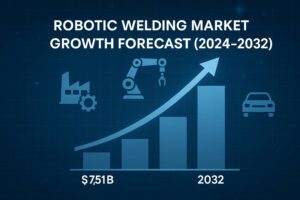
The robotic welding market has witnessed tremendous growth over the last few years. In 2024, it was valued at approximately $7.51 billion, and according to recent projections, it’s expected to soar to $13.2 billion by 2032, expanding at a CAGR of 7.42% between 2025 and 2032.

This growth is powered by rising labor costs, increasing demand for precision manufacturing, and the global push toward automation and smart production systems—collectively known as Industry 4.0.

What Factors Are Driving the Robotic Welding Market?

Several key trends are fueling this rapid expansion, and understanding them reveals why robotic welding is becoming indispensable in modern industry.

1. The Automotive Industry Leads the Way

The automotive sector remains the largest consumer of robotic welding systems. Modern vehicles require thousands of precise welds to ensure structural strength and safety. As global automakers shift toward electric and hybrid models, demand for precision welding in battery frames, chassis, and lightweight materials continues to grow.

2. Industry 4.0 Integration

Smart factories are no longer a futuristic dream—they’re a global reality. Integrating AI, IoT, and advanced robotics allows for predictive maintenance, process optimization, and real-time quality monitoring. These systems reduce downtime and increase productivity, making robotic welding an essential part of next-generation manufacturing.

3. Government Support for Automation

Government initiatives like “Make in India” and “Made in China 2025” are promoting automation and smart manufacturing. By offering tax benefits, subsidies, and policy support, these programs encourage industries to adopt robotic solutions, driving regional growth and innovation.

Which Regions Are Dominating the Robotic Welding Market?

Asia-Pacific: The Growth Engine

The Asia-Pacific region—especially China, India, and Japan—is leading global growth. With strong manufacturing bases, increasing labor costs, and supportive government policies, the region is expected to remain the largest and fastest-growing market for robotic welding systems. China’s vast automotive and electronics industries continue to set the pace, while India’s industrialization and manufacturing boom are driving fresh demand for automation.

North America: Innovation and Steady Growth

In North America, growth remains moderate but stable. The United States leads in adoption across the automotive, construction, and energy sectors, with companies investing in advanced robotic systems to maintain competitiveness and ensure product quality. The push for reshoring manufacturing back to the U.S. also encourages new investments in automated welding technologies.

Europe: Precision and Technology

Europe’s well-established automotive and industrial base ensures steady adoption. Countries like Germany and France continue to integrate advanced robotics, leveraging precision manufacturing as a competitive edge in the global market.

Who Are the Top Players in the Robotic Welding Market?

Some of the world’s leading robotics companies dominate this market, offering cutting-edge welding automation systems:

  • ABB (Switzerland) – Known for flexible, high-precision robotic arms.
  • Yaskawa Electric Corporation (Japan) – A pioneer in industrial robotics and motion control.
  • FANUC Corporation (Japan) – Renowned for reliable, high-speed robotic welders.
  • KUKA AG (Germany) – Specializes in collaborative robotic systems and smart factory integration.
  • Mitsubishi Electric Corporation (Japan) – Offers integrated automation solutions across industries.

These manufacturers are constantly innovating—introducing AI-enhanced robots, modular systems, and welding solutions that minimize error and optimize production efficiency.

What Are the Key Trends Shaping the Future of Robotic Welding?

1. Spot Welding Robots Continue to Dominate

Spot welding remains the most widely used robotic process, especially in automotive applications. These robots are space-efficient, deliver consistent weld quality, and are ideal for mass production lines.

2. Advanced Sensors and AI Integration

Future robotic welding systems will rely heavily on machine vision and AI algorithms to detect variations in material thickness, positioning, and alignment—ensuring every weld meets exact standards without human intervention.

3. Collaborative Robots (Cobots)

Cobots are transforming the workplace by safely working alongside humans. In welding, cobots improve flexibility for small-batch production while maintaining safety and consistency.

4. Sustainability and Energy Efficiency

As industries strive to lower carbon emissions, energy-efficient robotic systems that reduce waste and optimize material usage will gain traction, aligning with global sustainability goals.

How Can Businesses Benefit from Adopting Robotic Welding?

Implementing robotic welding brings several advantages:

  • Consistency and Quality: Robots eliminate human error and fatigue, ensuring every weld meets specifications.
  • Higher Productivity: Continuous operation and faster cycle times increase output.
  • Cost Efficiency: Despite high initial investment, reduced labor costs and fewer defects lead to strong long-term ROI.
  • Worker Safety: Automation minimizes exposure to fumes, heat, and hazardous conditions.

In short, robotic welding isn’t just a technological upgrade—it’s a competitive necessity for manufacturers aiming to thrive in the next decade.

Frequently Asked Questions

1. What industries use robotic welding the most?

The automotive, construction, aerospace, and metal fabrication industries are the primary users. Automotive remains the largest segment due to the volume and precision of welds required.

2. What are the main advantages of robotic welding?

Key benefits include improved precision, faster production, reduced material waste, enhanced safety, and consistent weld quality across mass production.

3. How does Industry 4.0 affect robotic welding?

Industry 4.0 connects machines, sensors, and analytics in real-time. For welding, it means predictive maintenance, automatic quality checks, and greater flexibility in manufacturing processes.

4. Which country leads the robotic welding market?

China currently leads in production and adoption, followed closely by Japan, Germany, and the United States.

Looking Ahead: The Future of the Robotic Welding Market

The robotic welding market is moving from being a luxury to a necessity for global manufacturers. As AI, data analytics, and automation converge, welding robots will become smarter, safer, and more adaptable.

With supportive government policies and industrial digitization accelerating worldwide, the next decade will likely mark a golden era for welding automation.

Jenna Clarke

Jenna explores how technology transforms business, productivity, and modern living. With a passion for digital transformation and innovation, she covers everything from AI tools to emerging trends. Her work empowers professionals to adopt forward-thinking strategies and thrive in the digital economy.

More From Author

Manufactured Housing Market Size, Growth Opportunities, and Forecast

Manufactured Housing Market: Size, Growth Opportunities, and Forecast

China Solid State Drive (SSD) Market

China Solid State Drive (SSD) Market: Size, Share & Growth Outlook 2021–2027

Manufactured Housing Market: Size, Growth Opportunities, and Forecast

If you told me five years ago I’d geek out over factory-built homes, I’d have laughed. Then I toured a modern manufactured home that felt warmer, smarter, and more affordable than many site-built houses I’d seen. That afternoon, the manufactured housing market stopped being a niche in my head and became a real answer to America’s affordability crisis. In this guide, I’ll break down size, growth drivers, financing realities, regulations, and what could shape the market through 2028.

What’s driving demand in the manufactured housing market right now?

Rising home prices and tight inventory push buyers toward alternatives that deliver value without sacrificing comfort. Manufactured homes typically cost far less than site-built homes, and they arrive with predictable timelines because builders construct them in controlled factory settings. Recent federal data shows average U.S. sales prices for new manufactured homes hovering near the low-$100Ks, with singles and doubles priced well below typical site-built equivalents. That cost gap acts as the market’s engine, pulling in first-time buyers, downsizers, and workforce households. 

Another tailwind: new-home supply dynamics. As traditional builders deal with labor and materials constraints, factory production offers speed and scale. Broader reporting on industrialized construction—modular, panelized, and 3D-printed concepts—underscores the push to build faster and cheaper to close the national housing shortfall. Manufactured homes are the most established factory-built option with a mature regulatory code and national distribution. 

How big is the manufactured housing market—and where is it headed by 2028?

Market sizing varies by methodology (retail value vs. shipments vs. community revenues), but the direction is clear: steady growth. Third-party estimates peg the U.S. manufactured homes market in the mid-tens of billions of dollars with mid-single-digit CAGRs over the next decade. Even with different baselines, analysts converge on growth fueled by affordability, improved design, and institutional interest in land-lease communities. 

On the volume side, industry tracking shows manufactured home shipments representing a meaningful share of single-family housing activity, with shipment share of starts and sales rising in recent years—a sign that the sector is gaining relevance during tight supply cycles. If mortgage rates ease and local zoning continues to open up, I expect shipments to trend upward through 2028. 

How big is the manufactured housing market—and where is it headed by 2028

What makes a home “manufactured” (and why does the HUD Code matter)?

Quick definition check: a manufactured home is built entirely in a factory to a national performance standard known as the HUD Code, first implemented in 1976 and regularly updated. This code governs design, construction, durability, fire safety, energy efficiency, and transport. 

Because the HUD Code preempts local building codes, manufacturers can produce at scale and deliver consistent quality across states. That uniformity underpins nationwide financing, appraisal, and warranty practices and differentiates manufactured homes from modular homes (which follow local codes) and from RVs or tiny homes. Recent federal rulemaking continues to refine the code—another plus for quality and consumer protections.

Where do pricing and buyer value stand in the manufactured housing market?

Affordability shows up in the data. Census “Manufactured Housing Survey” tables track average sales prices by region and home type (single-section and multi-section). Nationally, averages have clustered around the low-$100Ks for all homes, with single-section homes below $100K and multi-section homes around the mid-$150Ks in recent readings. That delta versus site-built homes gives buyers more home for the dollar and helps communities and developers add supply faster. 

For context, the MHS also provides square footage and selected characteristics by region, allowing apples-to-apples comparisons of size and cost. When I weigh price per square foot, manufactured homes typically deliver significant savings—one reason the sector attracts budget-sensitive buyers and workforce housing strategies. 

Where do pricing and buyer value stand in the manufactured housing market

How does financing actually work for the manufactured housing market?

Financing depends on title. If you place the home on land you own and title it as real property, you can often use conventional or government-backed mortgages. If the home sits on leased land in a community or remains titled as personal property, you usually rely on chattel (personal property) loans with different terms. The GSEs’ “Duty to Serve” plans aim to expand responsible financing options in manufactured housing, and Freddie Mac continues to explore feasibility for personal-property (chattel) products. This area matters: broader access to fair-cost financing could unlock more demand through 2028. 

What about insurance, installation, and warranties?

Insurers price risk based on location, construction, and installation quality. Proper installation to HUD standards and anchoring requirements reduces risk and protects resale value. Many manufacturers and retailers offer warranties, and state programs may add protections. As always, documentation and a HUD certification label (the “red tag”) help buyers and lenders verify compliance. 

How do communities fit into the manufactured housing market?

Land-lease communities offer amenities and lower up-front costs because you buy the home but lease the lot. Investor interest has grown, adding capital for upgrades—but also raising questions about rent stability. Local policy (e.g., notice requirements, rent caps, or resident purchase opportunities) can influence long-term affordability. These policies will shape the market’s trajectory in many metros between now and 2028.

What opportunities and constraints should investors and buyers watch through 2028?

Opportunities:

  • Affordability gap: As site-built prices stay high, manufactured homes remain a practical entry point.

  • Industrialized delivery: Factory processes reduce weather delays and waste, supporting scale.

  • Financing innovation: Duty-to-Serve initiatives and potential chattel enhancements could widen credit access.

Constraints:

  • Zoning and NIMBY resistance: Local restrictions can bottleneck placements.

  • Rate sensitivity: Higher borrowing costs slow sales, particularly for price-sensitive buyers.

  • Lot-rent dynamics: Community rent inflation can erode total cost advantages for some households.

What opportunities and constraints should investors and buyers watch through 2028

Frequently Asked Questions

1. Is the manufactured housing market really growing?

Yes. Multiple analyst houses project mid-single-digit compound growth, and shipment share of overall single-family activity has ticked up in recent years. Rising costs in the site-built market and improving HUD standards support the trend through 2028. 

2. How much does a new manufactured home cost today?

Census data shows average U.S. sales prices in the low-$100Ks overall, with single-section units under $100K and multi-section units in the mid-$150Ks (recent monthly readings). Prices vary by region, features, and installation. 

3. Do manufactured homes meet strict safety and energy standards?

They do. The HUD Code governs design, construction, fire safety, energy efficiency, and durability nationwide. Recent rulemaking has updated and strengthened standards, and homes carry a certification label to verify compliance.

4. Can I get a “normal” mortgage on a manufactured home?

Often, yes—if the home is permanently affixed to land you own and titled as real property. Homes on leased land or titled as personal property typically use chattel loans. GSE “Duty to Serve” efforts aim to improve access and liquidity across both paths. 

Conclusion: Where I see the manufactured housing market going by 2028

I expect the manufactured housing market to keep gaining share as buyers prioritize price-to-value, faster delivery, and energy-efficient designs. The sector’s national code, improving financing landscape, and data-driven pricing transparency give it structure that newer methods still lack. If zoning modernizes and chattel credit costs come down, manufactured homes will anchor many communities’ affordability strategies—delivering real homes to real people at prices that make sense.

Jenna Clarke

Jenna explores how technology transforms business, productivity, and modern living. With a passion for digital transformation and innovation, she covers everything from AI tools to emerging trends. Her work empowers professionals to adopt forward-thinking strategies and thrive in the digital economy.

More From Author

electric bike market

My Take on the Electric Bike Market: The 2021 Boom That Changed Everything

robotic welding market

Robotic Welding Market: Growth, Trends, and Future Outlook

Solar Electric Power Generation Market: Trends, Size, Share, and Outlook to 2028

The solar electric power generation market keeps breaking records, and the next few years look even bigger. From plunging panel prices to utility-scale storage and corporate clean-power deals, solar keeps stacking wins across technology, policy, and finance. Below, I unpack where growth comes from, who’s leading, what costs look like now, and how the market shapes up through 2028—plus where companies like ENGIE, Exelon/Constellation, Dominion Energy, Innogy/RWE, Tata Power, and Greenko fit into the story.

What Is Driving Growth in the Solar Electric Power Generation Market?

Three forces set the pace: cost, manufacturing capacity, and demand. First, costs continue to trend down. Independent analyses show utility-scale solar remains among the lowest-cost new-build power sources in the US and globally, even when you include financing and operating assumptions. Recent Levelized Cost of Energy (LCOE) studies confirm the advantage, and solar-plus-storage increasingly competes in peak and mid-peak hours. 

Second, manufacturing capacity exploded. By the end of 2024, global PV manufacturing capacity surpassed 1,100 GW—more than double projected demand—pushing module prices down sharply and tightening margins for producers. That near-term oversupply drives cheaper system pricing and accelerates deployments through 2028. 

Third, demand keeps setting records. IRENA reports renewables added 585 GW of capacity in 2024, with solar PV contributing the largest share; by early 2025, global solar stood around 1,865 GW after adding ~452 GW in 2024 alone. Policymakers’ goal to triple renewables by 2030 further pulls in investment and long-term offtake. 

What Is Driving Growth in the Solar Electric Power Generation Market

How Big Is Solar Now—and How Fast Can It Grow by 2028?

By end-2023, renewables made up 43% of global installed power capacity, with solar the top growth engine. Given manufacturing overcapacity and policy tailwinds, most credible scenarios expect solar to dominate renewable additions through 2028, accounting for the majority of new renewable capacity. The IEA projects solar will provide roughly 80% of renewable capacity growth between 2024 and 2030—momentum that easily spans the 2021–2028 window. 

In the US, the market remains cyclical quarter-to-quarter due to interconnection, trade, and tax-credit timing, but multi-year trajectory stays up and to the right. SEIA’s market insight shows substantial quarterly swings yet a robust medium-term pipeline across utility-scale, commercial, and rooftop segments under the Inflation Reduction Act. 

Which Companies Are Shaping the Solar Electric Power Generation Market?

ENGIE continues rapid global build-out, adding 4.2 GW of renewables in 2024 and reaching ~46 GW installed capacity (all renewables). The company also advanced battery storage to firm solar output and secured US tax-equity financing for a 1.3-GW portfolio (950 MW solar; 353 MW wind), underscoring the capital depth behind large pipelines. 

Exelon is now a regulated wires-and-meters utility after spinning off the competitive generation fleet into Constellation in 2022. This matters for market analysis: generation growth headlines (PPAs, merchant exposure) belong to Constellation, while Exelon focuses on T&D and programs that enable customer-side solar and grid integration. 

Dominion Energy plays a major role in clean capacity build-outs on the US East Coast, notably the 2.6-GW Coastal Virginia Offshore Wind project (not solar, but grid-scale renewables that complement solar’s profile). Dominion also advances utility-scale solar portfolios in its service territories, reflecting integrated resource plans that blend solar, wind, and storage. 

Which Companies Are Shaping the Solar Electric Power Generation Market

Innogy now sits within RWE and E.ON following European sector reshuffles. RWE absorbed Innogy’s renewables, becoming a top global player in wind and solar. When you see “Innogy” in older market URLs or reports, treat it as part of RWE’s renewables business from 2019 onward.

Tata Power scales Indian solar through utility projects, rooftop, and storage-backed hybrids. Recent PPAs for Mumbai distribution highlight how urban utilities use blended solar-wind-storage contracts for firm, peak-hour supply—an approach likely to spread across Asia-Pacific grids. 

Greenko leads India’s push into pumped-storage-backed renewables. Its Pinnapuram Integrated Renewable Energy Project combines multi-GW solar and wind with 1,200–1,680 MW of pumped hydro to deliver firm, dispatchable clean power—a template for balancing high solar penetration in emerging markets. Government and industry sources note multi-GWh storage and first units already commissioned, with long-term offtakes for continuous green power to industry.

What Technologies and Costs Will Matter Most Through 2028?

Solar-plus-storage will define peaking and evening supply. Updated LCOE+ frameworks show combined PV + 4-hour storage competing with gas peakers in many markets, especially where flexibility and capacity accreditation matter. Falling battery costs and tax incentives (in the US and elsewhere) reinforce this trend. Meanwhile, manufacturing oversupply keeps module prices low, though margins for producers stay tight. Expect developers to lock in cheap hardware and invest savings into grid integration, interconnection, and storage. 

Grid readiness will be the gating factor. Interconnection queues and transmission build-outs determine how much of the pipeline turns into electrons by 2028. Markets that streamline permitting and add high-voltage lines will capture more of the global capex wave.

Where Are the Opportunities by Region?

  • Asia leads absolute growth, with China, India, and Southeast Asia adding enormous volumes and accelerating hybrids with storage to serve evening peaks. India’s pipeline and record additions in FY26 illustrate the scale.

  • North America focuses on IRA-enabled utility projects, community solar, and corporate PPAs; storage coupling rises fast.

  • Europe continues rooftop and utility build-outs while reforming markets to reward flexibility—storage, demand response, and interconnectors—alongside PV.

How Does Market Structure Evolve Between 2021 and 2028?

From 2021 onward, three structural shifts stand out:

  1. From standalone to firmed renewables. PPAs increasingly specify hourly or 24/7 profiles, pushing developers to add storage or pair solar with wind and hydro (ENGIE, Tata Power, Greenko case studies).

  2. From merchant to contracted cash flows. Inflation-indexed PPAs, capacity payments, and IRA tax credits underpin bankability through 2028.

  3. From hardware-driven to grid-solutions-driven value. With modules cheap, value shifts to siting, interconnection, software, and storage sizing.

How Does Market Structure Evolve Between 2021 and 2028

Frequently Asked Questions

1. How big is the solar market today in capacity terms?

Global solar PV capacity reached roughly 1,865 GW after adding almost 452 GW in 2024, according to IRENA’s 2025 update—by far the largest annual solar build on record.

2. Are solar costs still falling in 2025–2028?

Yes. Module oversupply pushed prices to record lows in 2024, and LCOE analyses keep solar among the cheapest new-build options; solar-plus-storage also looks competitive for peak hours in many markets. 

3. Which companies should I watch?

Watch ENGIE (global renewables scale and US financing), RWE (absorbed Innogy’s renewables), Dominion Energy (large East Coast clean portfolio and offshore wind complementing solar), Tata Power (hybrid and storage deals in India), and Greenko (pumped-storage-backed firm renewables). Exelon now operates as a regulated utility after spinning off generation into Constellation in 2022. 

4. What’s the outlook through 2028?

Solar should remain the largest source of new power capacity worldwide. The IEA expects solar to deliver about 80% of renewable capacity growth from 2024–2030, and that dynamic will dominate through 2028—especially where transmission and storage keep pace.

Conclusion: The 2028 Playbook for the Solar Electric Power Generation Market

By 2028, the solar electric power generation market will be defined less by panel prices and more by deliverability: storage duration, grid access, and firm, hour-by-hour contracts. Companies that master hybrid design, interconnection strategy, and capital stacking will lead. With manufacturing capacity still abundant, policies aligned, and demand from utilities and corporates rising, solar remains the cornerstone of global power additions—cost-effective, scalable, and increasingly dispatchable.

Jenna Clarke

Jenna explores how technology transforms business, productivity, and modern living. With a passion for digital transformation and innovation, she covers everything from AI tools to emerging trends. Her work empowers professionals to adopt forward-thinking strategies and thrive in the digital economy.

More From Author

the acoustic fiber glass market

The Acoustic Fiber Glass Market: Why It’s Quietly Booming

electric bike market

My Take on the Electric Bike Market: The 2021 Boom That Changed Everything

The Acoustic Fiber Glass Market: Why It’s Quietly Booming

I’ll be honest—I never thought I’d find fiberglass fascinating. But the day I stood in a recording studio wrapped in panels that completely silenced the outside world, I got it. That surreal, peaceful stillness wasn’t magic—it was science, powered by one of the unsung heroes of modern construction: the acoustic fiber glass market. Once I started digging into it, I realized this market is shaping how we live, work, and even feel in our spaces.

What Exactly Is the Acoustic Fiber Glass Market and Why Should You Care?

What Exactly Is the Acoustic Fiber Glass Market and Why Should You Care?

When people hear “fiberglass,” they usually picture itchy insulation rolls tucked into walls. But acoustic fiber glass is a different kind of genius—it’s engineered to absorb sound while keeping energy efficiency high. Think concert halls, office buildings, schools, and even your favorite cafés where you can actually hear yourself talk.

The acoustic fiber glass market sits at the intersection of comfort, sustainability, and innovation. It’s not just about muting noise—it’s about improving how humans experience space. From energy-efficient homes to corporate soundscapes that enhance productivity, fiberglass has evolved from a basic building material into a modern necessity.

How Big Is the Acoustic Fiber Glass Market Right Now?

Here’s where things get impressive. The global acoustic insulation market, which includes acoustic fiberglass, was valued at around $16.76 billion in 2025. By 2035, experts expect it to reach $27.94 billion, growing at a 5.4% CAGR.

And that’s just one slice of the pie. The fiberglass market overall—which includes both insulation and composites—is set to grow from $26 billion in 2024 to $34.9 billion by 2030. The star performer? Glass wool, a type of acoustic fiberglass known for its superior sound absorption and thermal efficiency.

Here’s a quick snapshot for context:

Market Segment 2024/2025 Value Projected Value CAGR
Acoustic Insulation $16.76B (2025) $27.94B (2035) 5.4%
Acoustic Ceiling Tiles $6.4B (2022) $11.3B (2032) 5.8%
Fiberglass (Overall) $26B (2024) $34.9B (2030) 5.2%

The acoustic fiber glass market isn’t just expanding—it’s echoing through every layer of modern construction.

What’s Driving the Growth of the Acoustic Fiber Glass Market?

What’s Driving the Growth of the Acoustic Fiber Glass Market?

I’ve noticed a growing shift in how people design spaces. It’s not just about how a room looks—it’s how it feels. The hum of traffic, chatter from next door, or the echo of an open office can ruin your focus. That’s where this market shines.

Several key trends fuel its growth:

  1. Urbanization and Construction Boom: Rapid development across Asia-Pacific, especially in China and India, keeps pushing the demand for noise-reducing materials.
  2. Health Awareness: People now recognize that noise pollution isn’t just annoying—it’s harmful. Constant noise links to stress, poor sleep, and even heart problems.
  3. Energy Efficiency Regulations: Governments are tightening rules for insulation and sustainability, which naturally boosts acoustic fiberglass adoption.
  4. Design Meets Function: Architects and interior designers love materials that balance aesthetics with performance. Fiberglass ceiling panels and wall tiles do exactly that.

When I renovated my workspace, the acoustic panels made such a difference—I could finally take Zoom calls without my dog barking echoing like surround sound. That’s when I realized this market isn’t just commercial—it’s deeply personal.

Who Are the Big Players Shaping the Market?

Every industry has its titans, and the acoustic fiber glass market is no exception. Some companies dominate through innovation, others through sheer scale, but all of them are pushing boundaries.

  • Armstrong World Industries leads with cutting-edge acoustic ceiling and wall systems that blend art and engineering.
  • CertainTeed Ceilings (Saint-Gobain) is part of the global construction powerhouse, championing sustainable glass wool solutions.
  • Owens Corning practically invented fiberglass insulation and continues to innovate with its PINK Fiberglas brand.
  • Knauf Insulation brings a global touch with advanced glass and rock wool options.
  • Rockwool A/S goes beyond fiberglass, excelling in stone wool products with superior sound and fire resistance.
  • Johns Manville Corporation delivers a diverse line of fiberglass insulation materials trusted worldwide.

Each of these names contributes to the acoustic revolution happening across commercial and residential construction.

How Can You Benefit From the Acoustic Fiber Glass Market?

How Can You Benefit From the Acoustic Fiber Glass Market?

If you’re a homeowner, builder, or business owner, this market affects you more than you think. The beauty of acoustic fiberglass lies in its versatility—it enhances sound quality while lowering energy costs.

You can use it in:

  • Recording studios for clean, crisp audio.
  • Open offices to minimize chatter and distractions.
  • Home theaters for cinema-level sound.
  • Apartments and hotels to improve privacy and comfort.

Investing in acoustic fiberglass solutions today means future-proofing your spaces for better well-being, sustainability, and property value. I’ve seen even small soundproofing upgrades make homes feel more peaceful—and that’s priceless.

How to Choose the Right Acoustic Fiberglass Solution

I’ve made my fair share of mistakes when choosing materials for renovations, but I’ve learned a few things worth sharing.

Step 1: Identify Your Noise Problem

Is it echo inside the room or noise leaking from outside? The right product depends on where the sound originates.

Step 2: Pick the Right Product Type

Ceiling tiles work best for office acoustics, while wall panels or insulation rolls suit homes and studios. Glass wool panels are the go-to for both sound absorption and thermal balance.

Step 3: Don’t Skip Professional Installation

Acoustic performance drops dramatically if materials aren’t installed correctly. Always work with a certified installer who understands how to position panels for maximum impact.

The best part? You don’t have to be a sound engineer to make your space quieter—you just need the right materials and mindset.

FAQs About the Acoustic Fiber Glass Market

1. What makes acoustic fiberglass different from regular fiberglass?

Acoustic fiberglass focuses on sound absorption. It’s denser, strategically structured, and used in ceilings, walls, and panels to minimize noise and echoes while maintaining insulation benefits.

2. Is acoustic fiberglass safe for home use?

Yes, absolutely. Modern fiberglass products meet strict health and safety standards. They’re sealed or faced to prevent fiber shedding, making them safe for both residential and commercial environments.

3. Which countries lead the acoustic fiber glass market?

The Asia-Pacific region, especially China and India, leads the way due to construction growth. North America and Europe also hold strong positions because of energy efficiency mandates.

4. Can acoustic fiberglass help reduce energy bills?

Definitely. Since glass wool provides both sound and thermal insulation, it helps regulate indoor temperatures. That means your HVAC system works less, saving you money in the long run.

Shhh… The Future Sounds Promising

Here’s my favorite part—the acoustic fiber glass market isn’t just growing; it’s transforming how we experience silence and comfort. As cities get noisier, materials that promote calmness and efficiency will define the future of construction.

If there’s one thing I’ve learned, it’s this: silence is a luxury worth investing in. Whether you’re building a skyscraper or upgrading your home office, acoustic fiberglass doesn’t just mute the world—it lets you live better within it.

Jenna Clarke

Jenna explores how technology transforms business, productivity, and modern living. With a passion for digital transformation and innovation, she covers everything from AI tools to emerging trends. Her work empowers professionals to adopt forward-thinking strategies and thrive in the digital economy.

More From Author

10 Early Warning Signs of Depression You Shouldn’t Ignore

10 Early Warning Signs of Depression You Shouldn’t Ignore

Solar Electric Power Generation Market

Solar Electric Power Generation Market: Trends, Size, Share, and Outlook to 2028